Why do the security agencies wait till the proverbial last minute before arresting terrorists when there is credible information about a threat to the elections?

An advisory issued by the American Embassy warned its citizens of an increased threat in places frequented by Westerners in the country.

Pakistan's spy agency Inter Services Intelligence had drawn up a plan to target Buddhist religious sites in India to avenge the alleged atrocities against the Rohingya Muslim community in Myanmar.

The Indian Mujahideen, who allegedly carried out the attack, enjoyed the support of local political leaders, suspect investigators. Vicky Nanjappa reports

A suspected Indian Mujahideen terrorist was arrested on Tuesday by Maharashtra Anti-Terrorist Squad in connection with the 2011 serial bomb blasts in which 26 people were killed.

Criminal jurisprudence is based on an interesting saying, "It is better that ten guilty persons escape than one innocent suffer." However, that does not seem to apply to the Maharashtra Anti Terrorist Squad. There are several instances to show that the agency has botched up its investigation, the latest being Pune Bakery blast main accused Himayat Baig.

A twitter account, purportedly belonging to terror outfit Indian Mujahideen, has warned that the next target would be Mumbai, prompting the state authorities to tighten security across the city.

The Reserve Bank on Thursday asked banks and other financial institutions to report to the government details about accounts resembling 10 individuals who have been designated as terrorists by the Union home ministry earlier this month. On October 4, the Union Ministry of Home Affairs (MHA) had designated a total of 10 members of Hizbul Mujahideen (HM), Lashkar-e-Taiba (LeT) and other proscribed outfits as terrorists under the Unlawful Activities (Prevention) Act (UAPA). Those designated as terrorists include Habibullah Malik alias Sajid Jutt, a Pakistani national, Basit Ahmad Reshi, who hails from Jammu and Kashmir's Baramulla but is currently based in Pakistan, Imtiyaz Ahmad Kandoo alias Sajad, who hails from Jammu and Kashmir's Sopore but now lives in Pakistan, Zafar Iqbal alias Salim, who is from Poonch but presently residing in Pakistan, and Sheikh Jameel-ur-Rehman alias Sheikh Sahab, who hails from Pulwama.

What drives Pakistani men to join its military, despite the toll it takes on them?

The Delhi Police have finally managed to get their man -- Abdul Karim Tunda, the answer to several questions regarding the Lashkar-e-Tayiba network in India.
After a massive manhunt, the National Investigation Agency on Wednesday nabbed the elusive Students Islamic Movement of India operative Haider, who allegedly played a key role in the Patna blasts targeting Prime Minister elect Narendra Modi's rally last October.
.jpg)
The Intelligence Bureau has issued a grade A alert stating that all airports in the country are under a terror threat.
Jamaat-Ul Mujahideen Bangladesh activist Mohammed Masiuddin alias Abu Musa has been questioned by the Federal Bureau of Investigation in Kolkata to probe a possible conspiracy being hatched by his Syria-based handler Sultan Abdul Kadir Armar to target American assets and nationals.

The funds were allegedly raised by an operative from Ranchi named Uzair Ahmed.

Mumbai Police Commissioner Rakesh Maria has received a letter purportedly threatening a terror attack in the metropolis to "take revenge for Gaza" attacks, following which an alert has been sounded in Mumbai.
West Bengal has a 2,200 km porous border with Bangladesh over 10 districts.
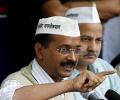
Does Delhi Chief Minister Arvind Kejriwal really face a terror threat?

Investigations in the Patna serial blasts showed an Indian Mujahideen link with the Jharkand police claiming on Monday that one of the two arrested terrorists who was believed to be the mastermind belonged to the nascent "Ranchi module" of the banned terror outfit.
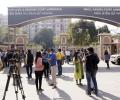
A special court in Ahmedabad on Friday awarded death sentence to 38 convicts in the 2008 Ahmedabad serial blasts case, which had claimed 56 lives and left over 200 injured.

The minister asserted that India has taken major action against terrorism under the Modi government and referred to the surgical strikes carried out across the Line of Control (LoC) in 2016 and the Balakot air strike in 2019.

Highly-placed sources in the Assam police said that several jihadi elements from different areas of Assam were working for terror outfits after undergoing training.

Statistics show the failure of the Bihar government in acting against Naxals in the state who are able to set up bases without much difficulty. Vicky Nanjappa reports

The lax security in jails is under scanner with recent episodes of breaks and murders of inmates, reports Vicky Nanjappa.
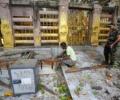
It might have taken several years, but the intelligence and security agencies in several states recently tracked down and arrested dreaded terrorists involved in creating havoc in the country. It began with the arrest of Zabbiuddin Ansari, an accused in the 2008 Mumbai terror attacks, then came the arrest of Indian Mujahideen co-founder Yasin Bhatkal followed by Lashkar-e-Tayiba bomb maker Abdul Karim Tunda, Zaveri Bazaar bomber Waqas Ahmed and now IM chief Tehsin Akthar. In a five-part series, Rediff.com's Vicky Nanjappa describes how each of these terrorists were painstakingly tracked by the Intelligence Bureau and arrested by the security agencies.

Syed Ahmad Shakeel and Shahid Yousuf, who are sons of Hizbul Mujahideen chief and one of the most wanted terrorists, Salahuddin, were also dismissed from service for allegedly being involved in terror funding, the officials said.

How Zabiuddin Ansari alias Abu Jundal, the Indian link in the 26/11 conspiracy, was captured after a painful 43-month chase.

The investigators hunting for leads in the Chennai blasts case say they are certain that a member of the banned outfit Al-Ummah executed the attack.

A call to the Alipore jail from Karachi last year is not something that can be taken lightly. After all, the call was made by one Jawed Baluchi to key Lashkar-e-Tayiba operative Aftab Ansari, who is serving a life sentence without remission in the 2002 American consulate attack case. Vicky Nanjappa reports

On May 24, 2022, a trial court in the national capital had awarded life imprisonment to Malik, the Jammu Kashmir Liberation Front (JKLF) chief, after holding him guilty of various offences under the stringent anti-terror law-Unlawful Activities (Prevention) Act (UAPA)-- and the Indian Penal Code.

Yasin Bhatkal, a dreaded terrorist and co-founder of terror-outfit Indian Mujahideen, who was arrested from the Indo-Nepal border in north Bihar, will be handed over to National Investigation Agency.

The outlawed terror group Indian Mujahideen is more lethal and resilient because of the support it receives from Pakistan, according to a new report by an American think-tank.
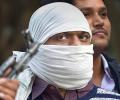
A Delhi court Monday awarded death penalty to Ariz Khan for the murder of decorated Delhi Police Inspector Mohan Chand Sharma in connection with the sensational 2008 Batla House encounter case, saying the offence fell under the 'rarest of the rare category' warranting the maximum sentence.

Some police encounters that stunned India.
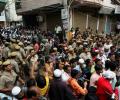
'It is possible that these terrorists took advantage of the chaos and escaped in the melee.'
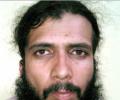
National Investigation Agency brought Dilsukhnagar bomb blast suspect and Indian Mujahideen co-founder Yasin Bhatkal to Hyderabad on a transit warrant on Sunday.

Indian Mujahideen co-founder Yasin Bhatkal and his associate were flown to Delhi by a special plane to Patna on Friday afternoon.

The man recruiting Indians for ISIS may be based in Sharjah.

He slammed the Samajwadi Party for being sympathetic towards terrorists and claimed that the previous government headed by it had sought to withdraw cases against several terror accused as 'a return gift'.

Rediff.com takes a look at some instances of underworld dons and terrorists detained or arrested in a foreign country and deported or extradited back to India.

Cops are also investigating whether personal enmity or property dispute was a reason behind the murder.
 © 2026 Rediff.com - Advertise with us - Disclaimer - Privacy Policy - Sitemap - Feedback - About us - Terms of use - Grievances